
What Is a Standing Jet Ski? A Beginner-Friendly Guide
If you have been researching personal watercraft online, you have probably come across the term standing jet ski and wondered what it means.
Most people picture a traditional jet ski with a seat where one, two or even three people can ride comfortably. Standing jet skis, however, are a different type of personal watercraft designed for a more active and athletic riding experience.
So, what is a standing jet ski? Is it harder to operate? Is it faster than a regular jet ski? And which type is better for beginners?
This guide explains the differences in simple terms so you can understand how stand-up jet skis work and decide which type of watercraft is right for you.
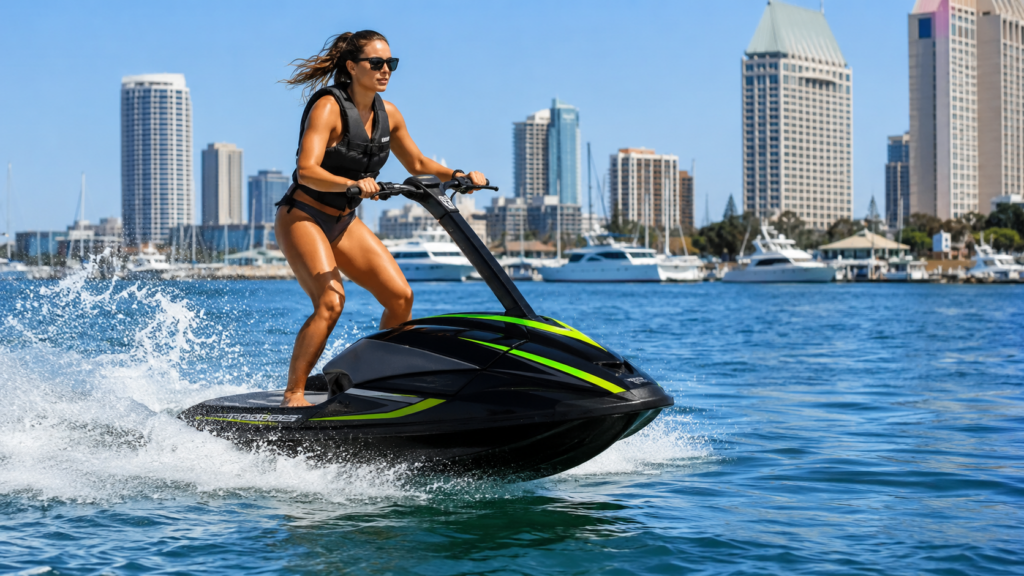
Quick definition: A standing jet ski is a compact personal watercraft operated while the rider stands on a rear platform instead of sitting on a seat.
What Is a Standing Jet Ski?
A standing jet ski, also called a stand-up jet ski, is operated while the rider remains upright. Instead of sitting on a padded seat, the rider stands on a platform at the rear of the watercraft and controls a movable handlepole positioned in front.
Before larger recreational jet skis became popular, stand-up models were among the first types of personal watercraft made available to the public.
Compared with modern sit-down jet skis, stand-up models are generally smaller, lighter and designed for agility rather than passenger comfort.
Because the rider stands throughout the experience, operating one requires more balance, coordination and physical effort than riding a traditional recreational jet ski.
How Does a Standing Jet Ski Work?
Mechanically, a standing jet ski works in a similar way to a standard sit-down model.
Both types use a jet propulsion system. Water is drawn into the watercraft and then pushed through a rear nozzle, creating the thrust needed to move forward.
The main difference is the rider’s position and how the watercraft is controlled.
On a sit-down jet ski, the rider is seated with a relatively stable center of gravity. On a standing jet ski, the rider must continuously adjust their body position while using their legs to absorb movement from the water.
Riding a stand-up model can feel similar to surfing, snowboarding or riding a motocross bike. The rider is actively involved in maintaining balance and controlling the movement of the craft.
Standing Jet Ski vs. Sit-Down Jet Ski
Although both watercraft provide an exciting experience, they are designed for different types of riders.
| Feature | Standing Jet Ski | Sit-Down Jet Ski |
|---|---|---|
| Riding position | Rider stands on a rear platform. | Rider sits on a padded seat. |
| Difficulty | Requires more balance, practice and coordination. | Generally easier for beginners to learn. |
| Stability | Less stable at low speeds and while starting. | More stable and comfortable for recreational riding. |
| Passenger capacity | Usually designed for one rider. | May accommodate one, two or three riders. |
| Best use | Sport riding, sharp turns, jumps and tricks. | Sightseeing, rentals, cruising and recreational use. |
| Physical effort | More demanding and athletic. | More relaxed and comfortable. |
Are Standing Jet Skis Faster?
Many people assume that standing jet skis are faster because they look smaller and sportier. However, that is not always the case.
Several modern sit-down performance jet skis can reach higher top speeds than stand-up models. Speed depends on the manufacturer, engine, model, rider weight and water conditions.
Many stand-up jet skis may reach approximately 45 to 60 miles per hour, depending on the specific model and riding environment.
The main attraction of a standing jet ski is not necessarily its top speed. Riders choose these machines because of their maneuverability, responsiveness and direct connection with the water.
Their lighter design allows skilled riders to perform tighter turns, jumps and tricks that may be more difficult on a larger recreational model.
Are Standing Jet Skis Hard to Ride?
Standing jet skis are generally more difficult to ride than standard sit-down models, especially for beginners.
One of the first challenges is learning how to remain balanced while the watercraft moves beneath you. New riders must also learn how to control the throttle, steer smoothly and shift their body weight without falling.
During the first few attempts, riders may spend time kneeling or moving at a low speed before they feel comfortable standing completely upright.
Most people can improve with practice, but stand-up models are typically better suited to experienced riders who want a challenging and athletic experience.
Beginner recommendation: Someone who has never operated a personal watercraft will usually have an easier and more enjoyable first experience on a stable sit-down jet ski.
Why Do Some Riders Prefer Standing Jet Skis?
Stand-up jet skis have developed a loyal following among personal watercraft enthusiasts.
Experienced riders often enjoy the challenge and physical involvement that comes with standing rather than sitting. Because the watercraft is smaller and lighter, the rider can make sharp turns and maneuver more aggressively.
Riders must continuously bend their knees, adjust their weight and respond to changes in the water.
This makes the experience feel more like an action sport than a relaxed sightseeing activity.
For many stand-up enthusiasts, the physical challenge is exactly what makes the experience exciting.
Are Standing Jet Skis Good for Beginners?
In most cases, a standing jet ski is not the best option for a first-time rider.
Visitors who want to enjoy a comfortable day on the water, see the scenery and quickly feel confident will usually prefer a traditional sit-down model.
Modern recreational jet skis are designed to provide greater stability and easier handling. After receiving a proper safety briefing, many first-time riders begin feeling comfortable within a few minutes.
Stand-up models require more practice, balance and physical effort. This can make them frustrating for someone who simply wants to relax and enjoy the experience.
For that reason, most jet ski rental companies provide sit-down models suitable for riders with different levels of experience.
Can You Rent a Standing Jet Ski in San Diego?
Stand-up jet skis exist, but they are much less common at rental businesses than traditional recreational models.
Most San Diego jet ski rental companies use sit-down watercraft because they are more stable, comfortable and accessible to a wider range of customers.
Rental operators must accommodate people with different experience levels. A sit-down jet ski allows visitors to enjoy the water without needing specialized stand-up riding skills.
For guests interested in exploring San Diego Bay, a sit-down jet ski provides a practical combination of speed, stability and comfort.
Why Most Visitors Choose Traditional Jet Skis
Most people visiting San Diego are looking for a memorable experience rather than a technical riding challenge.
Traditional sit-down jet skis offer several advantages:
- They are easier for first-time riders to learn.
- They provide a more stable and comfortable ride.
- Some models can accommodate two or three people.
- They are well suited for sightseeing and recreational cruising.
- They require less physical effort than stand-up models.
- They allow beginners to feel confident more quickly.
Whether you are riding near the Coronado Bridge, cruising along the waterfront or enjoying views of the downtown skyline, a traditional jet ski allows you to focus on the experience instead of constantly worrying about maintaining your balance.
The Best Place to Ride a Jet Ski in San Diego
San Diego Jet Ski Rentals offers access to one of Southern California’s most memorable waterfront riding locations.
The rental location is at Coronado Ferry Landing, 1201 First Street in Coronado, providing convenient access to San Diego Bay.
Depending on the approved riding route and current conditions, guests can enjoy views of:
- Downtown San Diego
- The Coronado Bridge
- Luxury yachts and sailboats
- Historic ships and naval vessels
- The San Diego waterfront skyline
- Coronado and the surrounding bay
Coronado Ferry Landing also provides restaurants, cafés, local stores and waterfront walking areas that visitors can explore before or after their reservation.
Parking policies and availability may vary, so guests should verify current parking information before arriving.
Final Answer: What Is a Standing Jet Ski?
A standing jet ski is a smaller and more athletic type of personal watercraft operated while the rider stands instead of sitting.
Stand-up jet skis provide excellent agility and an exciting connection with the water, but they require more skill, balance and practice than traditional recreational models.
For most visitors and first-time riders, a modern sit-down jet ski provides a better combination of excitement, comfort, stability and ease of use.
Ready to Experience Jet Skiing in San Diego?
Explore beautiful San Diego Bay with San Diego Jet Ski Rentals from Coronado Ferry Landing.
Enjoy a stable, beginner-friendly jet ski while taking in some of the best waterfront views in Southern California.
Reserve Your Jet Ski TodayPosts
- How much does it cost to rent a jet ski in San Diego? (July 16, 2023)
- Does San Diego have jet skis? (August 16, 2023)
- Is Sea-Doo or Yamaha jet ski better? (September 17, 2023)
- Is 50 Hours on a Jet Ski a Lot? (October 18, 2023)
- Is it Hard to Get on a Jet Ski? (November 1, 2023)
- Can a beginner ride a jetski? (December 21, 2023)
- What speed is the most efficient for a Jet Ski? (January 1, 2024)
- Is it safe to ride a jet ski if you can’t swim? (February 8, 2024)
- What is the weight limit for jet ski riders? (April 23, 2024)
- Do Jet Skis Flip Easily? (May 23, 2024)
- Can 2 People Sit on a Jetski? (June 16, 2024)
- How Many Miles Can You Ride on a Jet Ski? (July 16, 2024)
- Where Can I Ride My Jet Ski in San Diego? (August 16, 2024)
- Can Two People Sit on a Jet Ski? Everything You Need to Know (December 30, 2024)
- “Sea-Doo vs. Yamaha Jet Ski: Which One is Better for You?” (January 27, 2025)
- Does San Diego Have Jet Skis? Here’s Everything You Need to Know (April 15, 2025)
- Do Jet Skis Have a Weight Limit? Here’s What You Need to Know (May 15, 2025)
- What Are the Requirements to Ride a Jet Ski in San Diego? Everything You Need to Know (June 5, 2025)
- Top 5 Places to Ride a Jet Ski in San Diego – Requirements and What You Need to Know (July 1, 2025)
- What is the Rental Process for Jet Skis at San Diego Jet Ski Rentals? (August 1, 2025)
- Where to Rent Jet Skis in San Diego? Your Ultimate Guide (August 15, 2025)
- Can You Rent Jet Skis in San Diego? Here’s Everything You Need to Know (September 12, 2025)
- What Is the Top Speed of a Jet Ski? Everything You Need to Know (October 17, 2025)
- What Not to Wear on a Jet Ski in San Diego (And What to Wear Instead) (March 31, 2026)
- Mission Bay vs San Diego Bay Jet Ski Rentals: Which Is Better? (May 7, 2026)
- Is Jet Skiing in San Diego Worth It? Here’s What You Need to Know (May 30, 2026)
- How Old Do You Need to Be to Drive a Jet Ski? (June 8, 2026)
- How Fast Do Jet Skis Go? Everything You Need to Know AS A FIRST TIMER (June 12, 2026)
- How Much Does a Jet Ski Weigh? A Complete Guide for First-Time Riders (June 18, 2026)
- What Is a Standing Jet Ski and Is It Better Than a Regular Jet Ski? (June 26, 2026)
- Is Mission Bay or Coronado better for jet skiing in San Diego? (July 10, 2026)
- Your First Jet Ski Ride in San Diego: Why Beginners Love San Diego Bay (July 16, 2026)
- 5 Thrilling Landmarks You’ll See on Your Jet Ski Ride (September 2, 2026)
- 3 Secrets to the Best Summer Jet Ski Ride (September 15, 2026)
- 3 Secrets to the Best TwitchCon San Diego Break (October 6, 2026)
Pages
- SD Jet Ski Rentals (March 24, 2023)
- Privacy Policy (March 24, 2023)
- Location (June 1, 2023)
- Blog (June 14, 2023)
- Coronado Jet Ski Rentals (July 17, 2023)
- SD Jet Ski Rentals (July 25, 2023)
- Mission Bay Jet Ski Rentals (July 25, 2023)
- Carlsbad Jet Ski Rentals (July 26, 2023)
- La Jolla Jet Ski Rentals (July 26, 2023)
- SD Jet Ski Rentals Spring Promo (May 5, 2025)
- san diego waverunner rental (July 16, 2026)